

Community Spotlight: Human-Centered AI for Workforce Health with Carey-Jo Hoffman
Where PrimeHealth Began
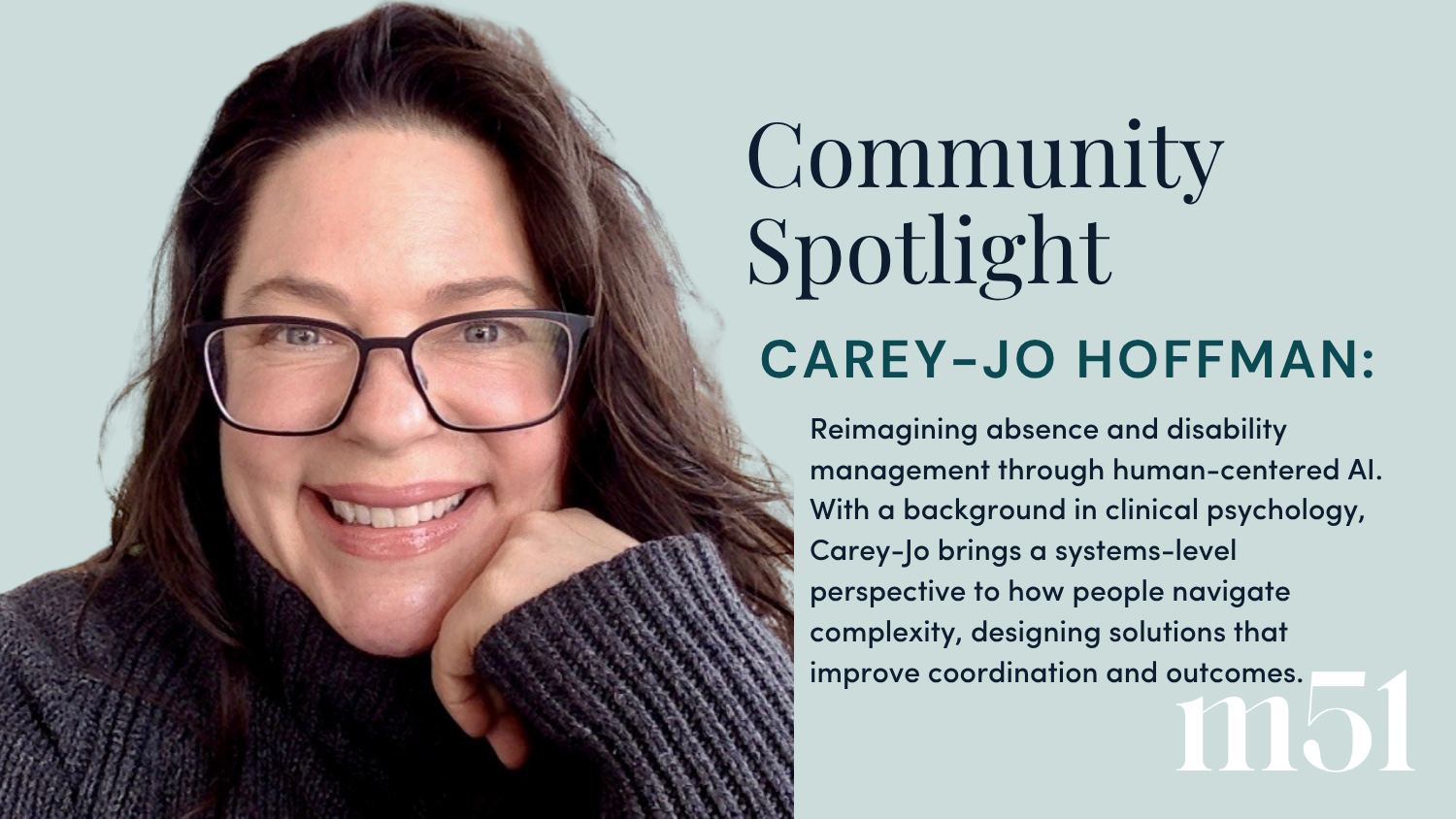
Carey-Jo Hoffman has spent her career examining how people move through complex systems under pressure. With a background in clinical psychology and nearly two decades of experience as a psychotherapist and educator, she brings a systems-level understanding of how individuals navigate uncertainty, decision-making, and care.
That perspective became deeply personal when she and her co-founder Rob found themselves coordinating care for aging family members. They experienced firsthand how difficult it can be to navigate fragmented healthcare systems, where appointments, medications, and critical information are often scattered across multiple people and institutions.
The experience revealed a broader coordination problem that would eventually lead to PrimeHealth, an AI-powered platform designed to modernize absence and disability management for large organizations.
Before entering the technology sector, Carey-Jo completed graduate studies in both performing arts and clinical psychology, including work at Naropa University and the Chicago School of Professional Psychology. That interdisciplinary background continues to shape how she approaches complex systems and how people move through them under pressure.
The company originally launched as ElderPrime, a platform designed to help families coordinate care for aging relatives. As the technology evolved, Carey-Jo and her team recognized the same coordination challenges exist when employees navigate illness or injury.
In December 2024, the company pivoted to PrimeHealth, applying the backbone of the original platform to workforce absence and disability management. Today, the company is building technology that helps organizations coordinate recovery and return-to-work processes more effectively while improving outcomes for both employers and employees.
Rethinking How Enterprise Technology Gets Used
PrimeHealth approaches enterprise technology by designing systems with the human nervous system in mind.
In many organizations, resistance to new systems is treated as a compliance problem. If people are not using the tool, the assumption is that they need more training or stricter enforcement. But in complex environments like healthcare and large workforce systems, professionals are often already operating under significant cognitive and emotional load.
When technology introduces ambiguity or uncertainty, people adapt in predictable ways. They double-check information, build side systems, or avoid the platform altogether.
PrimeHealth operates from a different premise. Enterprise platforms should increase human capacity rather than strain it. As automation and AI become more embedded in workplace systems, Carey-Jo emphasizes the importance of designing technology that supports the people using it.
The platform is being designed in close collaboration with Fraser Health Authority and the BC Nurses’ Union, drawing on the expertise of professionals who manage return-to-work and disability cases every day. This ensures the system reflects real workflows and supports adoption at scale.
PrimeHealth also considers the experience of employees navigating illness or injury. These situations often involve multiple stakeholders while individuals are trying to recover. By reducing cognitive load and providing a clearer sense of where someone is in their recovery and return-to-work journey, the platform helps people feel more informed and supported.
Internally, the company applies the same philosophy to its culture. PrimeHealth is a neurodivergent-affirming workplace and encourages team members to experiment with AI tools to improve efficiency and problem-solving. The focus is on working more effectively, not simply faster.
Building Momentum
Over the past year, PrimeHealth has made significant progress in both product development and partnership building.
The platform is being developed in collaboration with Fraser Health Authority and the BC Nurses’ Union, where teams are helping inform and refine the system within a real operational environment.
PrimeHealth also participated in the Movement51 accelerator and the Spring Grow accelerator, programs designed to support high-potential companies and strengthen investor readiness.
Internationally, the company was selected as a Beta Startup at Web Summit and featured in the B.C. Pavilion Venture Spotlight at Web Summit Vancouver 2026.
Carey-Jo has also spoken at industry and investor events, including The51’s Road to the Summit in Vancouver and the Western Angel Investment Summit in Victoria, exploring how human nervous system dynamics influence decision-making in high-stakes environments.
What Growth Looks Like from Here
PrimeHealth is focused on expanding implementation with Fraser Health Authority and the BC Nurses’ Union through a paid pilot partnership.
The pilot represents the first stage of a broader rollout. Discussions are underway to expand the platform across additional unions and workforce groups within Fraser Health Authority, with potential to scale across other health authorities in British Columbia.
Because the platform is being designed in close collaboration with operational leaders, product development and implementation planning are happening simultaneously. This creates strong alignment between technology, leadership, and union stakeholders.
Early results suggest meaningful operational and financial impact. Absence and disability management often involves fragmented communication between employees, unions, managers, healthcare providers, insurers, and HR teams. PrimeHealth brings these groups into a shared coordination platform while supporting compliance with legislation and workplace policies.
Beyond healthcare, the company is building a growing B2G and B2B pipeline, with conversations underway with public sector organizations and large private employers.
The Shift Happening in Enterprise AI
Carey-Jo is closely watching the growing recognition that enterprise AI adoption is as much a human systems challenge as it is a technical one.
Organizations often assume that if a platform is technically sound, adoption will follow. But in complex environments where professionals already carry significant cognitive load, technologies that increase uncertainty can slow decision-making and reduce trust.
The next generation of enterprise platforms will need to focus not only on automation, but on expanding human capacity. Systems that provide clarity, coordination, and transparency can support better collaboration and decision-making.
PrimeHealth’s work with Fraser Health Authority and the BC Nurses’ Union reflects a broader shift toward building technology informed by the people who will ultimately use it.
What She Knows Now That She Didn’t Before
Carey-Jo believes one of the most important skills founders can develop is the ability to hold two opposing truths at the same time.
Founders need the confidence to build something new while maintaining the discipline to reassess as new information emerges. Markets change, and sometimes the smartest move is to pivot or walk away from an idea.
She also encourages founders to recognize what she calls “the polite Canadian no”. In the startup world, relationships that appear promising can quietly consume time and energy without moving forward.
Carey-Jo advises founders, especially women, to think carefully about when and why they raise capital. Venture funding can accelerate growth, but early customers and pilot partners can often create stronger long-term leverage.
Above all, she emphasizes the importance of taking care of yourself. Entrepreneurship is a long-term cognitive practice, and maintaining clarity allows founders to make better decisions for their companies and teams.