

M51 Community Spotlight: Building a Better Way To Bake - Atome Bakery with Alice Couderc
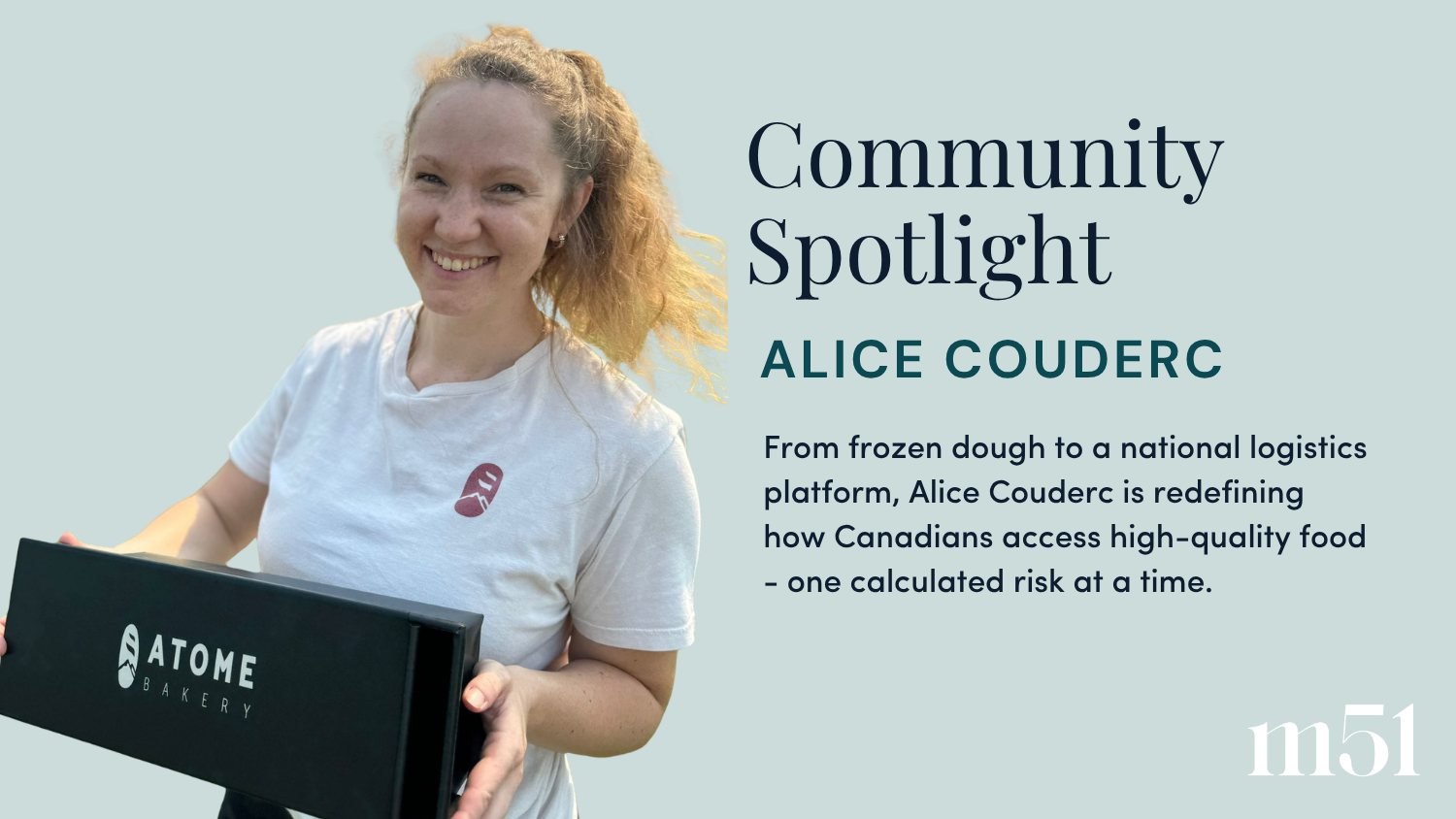
Community Spotlight: Alice Couderc of Atome Bakery
Building a Better Way to Bake
Some business ideas begin with a simple craving.
For Alice Couderc and her co‑founder, Lucas, it was the search for good bread after moving from France to Canada. Missing the quality they were used to, Lucas began experimenting with a technique common in French bakeries: freezing fully proofed dough so it could be baked fresh at home. What started as a personal solution quickly grew into something more when friends began asking to buy it.
Couderc came into the business from a different angle. Her early career in private equity consulting, followed by roles at Delivery Hero and DoorDash, shaped how she thinks about building companies through the lenses of operational efficiency, margin discipline, and scale. An obsession with logistics and consumer behaviour has guided her approach from the start.
Atome Bakery sits at the intersection of these two perspectives: artisanal French baking and a rigorously modern, systems‑driven approach to growth.
⸻
Rewriting the Playbook
Atome delivers frozen, ready‑to‑bake sourdough bread and pastries directly to customers across Canada through a direct‑to‑consumer model, meaning products are shipped straight to customers rather than sold through grocery retailers. The premise is simple. Dough is shipped frozen and baked fresh in customers’ own ovens. There are no additives, just water, flour, and salt.
For Couderc, the appeal lies in the clarity of both the product and the problem it solves. Atome uses a bake‑from‑proof method, meaning the dough is fully proofed before freezing and the customer completes the final bake at home. The result is far closer to a true bakery experience than anything traditionally found in the frozen aisle.
Behind the scenes, Couderc has led the buildout of DTC frozen shipping infrastructure across Canada, including rural delivery, without an existing blueprint. “We didn’t find a playbook, so we wrote one,” she explains.
⸻
Scaling Across Canada
In September 2025, Atome expanded into Ontario. Within three months, the province accounted for 40% of monthly sales. It was an early signal that demand extended well beyond the West Coast.
That momentum is now moving east, with Quebec and Atlantic Canada next. As a bilingual founder, Couderc sees French Canada as a natural fit, both culturally and operationally.
The path has been far from linear. The company exited the U.S. market following tariffs and customs uncertainty that disrupted unit economics. While difficult, the move clarified where to focus and allowed Couderc to double down on Canada with greater discipline.
⸻
Solving for What Doesn’t Exist (Yet)
One of Atome’s biggest constraints is also its biggest opportunity. Frozen direct‑to‑consumer logistics in Eastern Canada remain an unsolved problem. There is no turnkey solution at scale.
In response, Couderc and her team have developed a hybrid model that manages inventory consolidation, dry‑ice coordination, and carrier logistics internally. It is not a long‑term fix, but it has allowed the company to keep moving while building toward something more durable.
⸻
What’s Next
Atome is deepening its presence in Quebec and the Maritime provinces. These are markets that are both culturally aligned with Atome, and logistically underserved. The larger opportunity is geographic, not demographic. Rural and remote communities, often overlooked due to logistical complexity, are central to the company’s growth strategy.
As Couderc explains, “People in smaller towns have limited access to quality food, and our model works anywhere a courier reaches in two to three days.”
That focus reflects how she thinks about access. Not as a niche, but as a meaningful gap worth solving.
At the same time, Atome is expanding beyond its own products. The company has launched a frozen DTC fulfillment arm to support other consumer packaged goods brands, such as food and beverage companies, that want to ship directly to customers without relying on traditional retail distribution. This opens a channel that previously did not exist for many of them.
⸻
A Shift in How We Eat
Couderc is clear about the shifts shaping how people buy and think about food. Clean label is no longer a differentiator. It is the baseline. Consumers are paying closer attention to ingredients, and simplicity is easy to understand and trust. “Three ingredients is a very easy story to tell.”
At the same time, frozen food is being redefined. What was once seen as a compromise is increasingly viewed as intentional, high‑quality, well‑made, and worth choosing.
The infrastructure around it is still catching up. In Canada, direct‑to‑consumer frozen food remains early. Consumer habits, logistics, and trust in ordering perishables online are still developing. This creates an opening for companies willing to build ahead of demand.
Couderc is building with that future in mind, positioning Atome not just for how people buy today, but for where the market is going.
⸻
Advice for Founders
When asked what she would do differently in her entrepreneurial journey, Couderc says she would raise more capital earlier. Cash flow remains one of the most consistent pressures for fast‑growing companies, particularly for founders navigating systems not designed with them in mind.
She is equally clear on what people often get wrong about entrepreneurship. The idea is not the hard part. Staying with it is. Progress is built through the accumulation of small, often invisible decisions and through the willingness to change direction when the evidence demands it.
Her approach to leadership is grounded in preparation. Knowing your numbers inside and out isn’t just about credibility, she explains - it's about control. When the details live in your head, not just in a deck, it fundamentally changes how you show up in front of potential investors.
One surprising principle continues to guide how she builds, even as the company scales: “Do things that don’t scale.”
It’s counterintuitive for a founder leading a logistics‑heavy, operations‑driven company, but for Couderc it has been essential. Rather than over‑engineering systems too early, the focus is on testing ideas quickly, even if the process is manual, inefficient, or incomplete. The first version is rarely the one that lasts. What matters is learning fast enough to improve it. This philosophy shaped Atome in its earliest stages. Before formalizing operations, the team focused on making the product work, getting it into customers’ hands, and understanding what actually mattered. Only then did they begin building structure around it.
Progress, in practice, comes from iteration, not from waiting for something to feel finished.